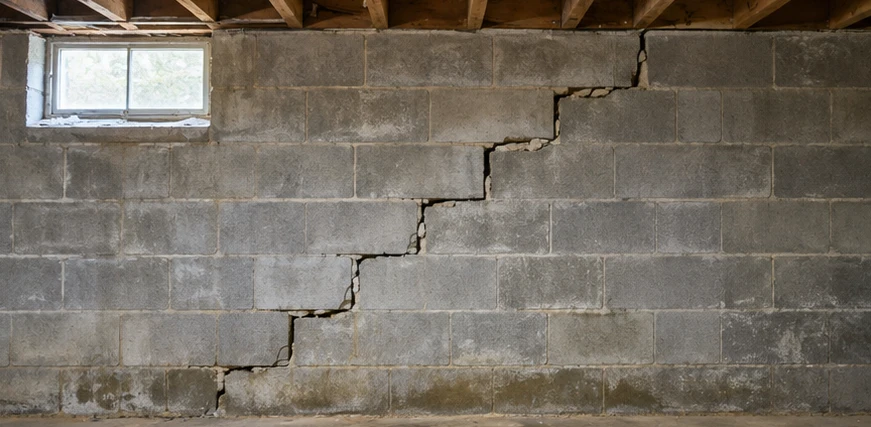
A crack in a concrete block wall raises an immediate question: is this a mortar repair or something more serious? The honest answer is that a photograph or a crack’s shape alone cannot establish the wall’s safety or the right repair. The wall’s role, construction, history and movement all matter.
You can still collect useful information without trying to diagnose it yourself. A clear record helps a masonry contractor or other qualified professional understand the concern and decide what evaluation is needed.
Start with the wall’s location and use
Is the crack in an exterior commercial wall, a basement foundation, a garage or an interior partition? Is the wall below grade, exposed to weather or carrying loads from above? You may not know all those answers, and that is worth saying rather than guessing.
Also note what is nearby: a door or window, a roof or floor connection, an outside downspout, a change in ground level, or equipment that could have struck the wall. These details provide context without establishing a cause.
Record what you can see safely
Take a wide photograph showing the wall and closer views showing the crack. If a scale can be placed safely near the crack without touching loose masonry, it may help document its appearance. Keep the photos with the date they were taken so changes are easier to discuss later.
- Does the crack follow mortar joints, pass through blocks, or do both?
- Is there visible displacement between the two sides?
- Are any blocks loose, broken or missing material?
- Is the wall visibly bowed, leaning or bulging?
- Has the condition changed, or is its history unknown?
- Is there dampness or a known water-entry problem nearby?
Do not stand beneath unstable material, push on the wall or remove pieces to improve a photograph. If there is falling material, significant displacement or concern about imminent instability, keep people clear and seek prompt professional assessment.
Why the crack pattern is only a clue
Horizontal, vertical and stepped cracks can occur under different conditions. Online diagrams can be useful for learning terms, but they do not substitute for evaluating the actual building. A stepped crack should not automatically be labeled harmless, and a narrow crack should not automatically be treated as a cosmetic problem.
The history matters too. A crack that has been stable for a long time presents a different information set from one that appeared suddenly or is visibly changing. Even then, the person evaluating the wall needs to consider the structure and surrounding conditions, not the timeline alone.
Distinguish three different goals
Repointing renews deteriorated mortar joints. Block repair can address damaged masonry units or localized areas within an agreed scope. Structural stabilization or reconstruction addresses a different set of requirements and may need engineered design.
A coating or parge layer can change the surface appearance but does not establish that a moving wall has been stabilized. Likewise, filling a visible crack does not by itself explain why the crack formed or show that movement has stopped.
Water concerns deserve a separate conversation
For a basement or below-grade wall, owners may be worried about both cracks and water. Those concerns can overlap, but repairing masonry is not automatically a complete waterproofing or drainage solution. The source and behavior of the water should be considered.
Describe whether dampness appears after heavy rain, snowmelt or another event. Do not assume that sealing the visible interior crack will address exterior drainage conditions. Clarify which issues the proposed scope is intended to address and which need separate attention.
What to ask at the next step
Ask whether the visible condition appears suitable for routine masonry work or whether additional professional evaluation is recommended before repairs are selected. If a repair is proposed, request clear limits: which units and joints, what preparation, and how unexpected conditions will be handled.
For a Rochester property owner, the most useful starting point is accurate documentation and a defined review, not an online diagnosis. A broader masonry assessment can help separate the visible repair work from questions that belong with a structural or other specialist.
Have a repair in mind?
Send your property location, a description and clear photographs. A defined scope starts with the conditions at your building, not a generic repair prescription.
Discuss your project →General guidance only. Concealed conditions, structural questions and local approval requirements may need an on-site review or a qualified design professional.